
Last month I had the pleasure of teaching at the Colorado VMA’s small ruminant meeting, and it got me thinking about some of the common misconceptions and mistakes made when using ultrasound to diagnose pregnancy in sheep and goats. I thought I might take this opportunity to highlight my top five tips.
Recent Posts
The Benefits of Everyday Ultrasound
With our next generation EVO® II and FASTVet™, you can be using ultrasound EVERY DAY in your companion animal practice!
With FASTVet™ techniques, you don’t need to be an expert sonographer to assess and monitor your patients. These are standardized, goal-directed exams that any veterinarian can easily learn and implement. Built-in procedural videos provide immediate assistance in performing FASTVet™ protocols. And in emergencies, no other tool offers such unparalleled, exigent diagnostic assistance.
Understanding Gain in Ultrasound
All ultrasounds have gain control. It’s often a knob, button, and/or a series of sliders on the console, and it’s one of the most used and adjusted scanning parameters... but do you know what it really does?
Most people think of gain as a brightness adjuster, and while it’s true that turning your gain up will brighten the image, it’s helpful to understand how it actually works. Gain is a uniform amplification of the ultrasonic signal that is returning to the transducer after it travels through the tissue. So rather than brightening the monitor, the image on the screen is whitened by a uniform margin, as though the returning signal is stronger than it is, to make it easier to see.
Topics:
explaining ultrasound images
portable ultrasound features
Ibex ultrasound video
mobile ultrasound
ultrasound image diagnosis
veterinary ultrasound machines
Ibex Portable Ultrasound
How to Ultrasound
ei medical imaging ultrasound
veterinary practice
Know before you buy ultrasound
features of ultrasound
built for veterinarians
portable rugged veterinary ultrasound
Understanding gain
Choosing the Correct Transducer
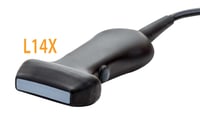 There are an overwhelming number of transducer (probe) options on the market these days, marketed for different species and applications. What do you need to consider when selecting one? Whether you are shopping for a new system or transducer, or simply deciding which of your current probes to use for a specific purpose, here are a few tips to keep in mind.
What Impact Does Frequency Have on Ultrasound Imaging?
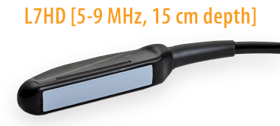 You’ve probably noticed that the transducers, or probes, on your ultrasound system are named or marked with a number followed by ”MHz”, most likely in the 1-20 range. Often this is how a company advertises their products – for example, a 7MHz linear rectal transducer. Perhaps you’ve wondered what this number refers to or the significance of having a higher or lower number on your probe.
How Does Ultrasound Work?
If you’re new to ultrasound, an image may look like nothing more than a swirling array of grey tones on the screen. Interpretation requires an understanding of anatomy and physiology, but also of how ultrasound technology functions.
Consider the sonar produced by a bat in flight. The bat emits high frequency sounds, which then bounce off of objects in its proximity and return to the bat. The animal uses the strength, direction, and timing of the returning sound to determine where those objects are and to avoid a collision.
Topics:
explaining ultrasound images
image quality ultrasound
How to Ultrasound
equine pregnancy ultrasound
portable veterinary ultrasound
Equine Portable Ultrasound
best portable bovine ultrasound images
bovine veterinary ultrasound
Portable Ultrasounds
ultrasound image
how to read an ultrasound image
rugged ultrasound
Portable UItrasound Machines
Ultrasound
built for veterinarians
frequency and ultrasound imaging
equine reproduction ultrasound
equine pregnancy
bovine reproductive ultrasound
cow herd reproduction
equine reproductive ultrasound
barn tough
high resolution veterinary ultrasound
Ultrasound Basics: How to Read an Ultrasound Image
Have you ever looked at an ultrasound image and wondered what are you looking at? Ever wonder which end is up? When others are discussing bull or heifer, ovarian diagnosis, or metritis treatment are you still looking to decide what it is?? Well, if you feel left in the dark when it comes to ultrasound images…..let’s start back at the basics.
Ultrasound is a non-invasive, immediate tool used to image tissue. It will not penetrate bone (like an X-Ray). So the first step to help you read the ultrasound image is to be familiar with the anatomy that you are imaging.
Just how portable is your ultrasound equipment?

With equine breeding season officially underway, you may be finding yourself re-evaluating your equipment. Technology changes at lightning speed, and it’s certainly possible that the reliable old ultrasound you’ve been using for years is just pretty darn obsolete now. While many factors must be considered in the search for a new one, I’d like to take a minute to talk about portability.